 The Peat Fire Flame
The Peat Fire Flame
The Peat Fire Flame
Castlebay - 1988 The Long Isle - 1989 The Peat Fire Flame - 1990 Down To he Shore - 1991 Harvest - 1992 Angels We Have Heard (1)- 1994 Faeries Hornpipe - 1994 Looking Home - 1995 The Skye Suite - 1996 Angels We Have Heard (2) 1997 Song of the Sea - 1998 The Ballad of Cappy John - 1999 Ladies - 1999 In a Garden Green - 2000 Sea & Skye - 2001 Gentlemen - 2002 Yuletide Treasure - 2002 Cottage & Castle - 2003 Ae Fond Kiss - 2003 Imram - 2004 The Night the Whiskey Froze - 2004 Islands In Time - 2006 Banks & Braes - 2007 The Grand Design* - 2007 Harvest Home - 2007 Going Home - 2008 Rantin', Rovin' Robin - 2009 Bards & Blarney - 2009 2010 Yuletide Revelry - 2010 Imbolc - Rekindling the Flame* - 2010 Festival of Faeries - 2011 John Earthy's Tavern* - 2012 Bound Away - 2015 Samhain - Banking the Fire - 2017 Winter Moon - 2019 Bygone Ballads of Maine, Vol I (book) 2021 Sundrie Aires - 2023 The Maid on the Shore - 2024
* These recordings have extensive notes.
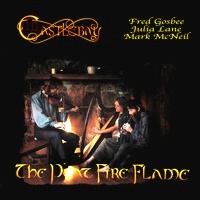

An array of Scottish songs arranged and performed in Castlebay's vibrant style, recorded as performed in concert.
Fred Gosbee - vocals, 5-string viola made by Alan Carruth, Fender 12-string guitar, whistles of his own construction adapted from a design by Gordon Bok, Yamaha bass recorder, foot chimes.
Julia Lane - vocals, nylon string clarsach built by Fred Gosbee, Roland RD300S digital piano/harpsichord.
Mark McNiel - vocals, violin, cello, flute, whistles, Seagull 6-string guitar, Roland RD300S digital piano with Roland MT12 sound module, Korg PSS680 synthesizer, Yamaha electric bass
Many thanks to Wayne Bean, the Chocolate Church, Bristol School, John and Fran Morriss, our audiences for their enthusiasm and support that make recording worthwhile, and especially to Joyce for her priceless instruction and encouragement.
Recorded and mixed at Barra Audio Productions, Brunswick, ME, on a Teac A3440 4-track, except for the Highland Suite which was recorded live on a TASCAM TSR-8 *-track.
Digitally mastered (for cassette) at Treefrog Productions, Hollis Center, ME. Remastered for CD in 2020 at Harper's Wood, Round Pond, ME.
Engineer Mark McNeil
Photography Carla Dolloff, Newcastle, ME
Originally released on Outer Green Records #OGR-8894-C

Band O' Shearers 1:03
Traditional
A bothy ballad sung by the lowland Scots farm workers. The shearing refers not to sheep but to the harvest of grain using a hook or sickle.
Bonnie lassie will ye gang And shear wi' me the hale day lang And love will cheer us as we gang And join yon band o' shearers
Summer days and heather bells Come bloomin' o'er yon high high hills There's yellow corn in all the fields And summer brings the shearin'
And if the weather be ower hot I'll cast my gravat and my coat And shear wi' ye among the lot When we join yon band o'shearers
And if the weather be ower dry They'll say there's love 'twixt you and I But we will proudly pass them by And we'll gang nae mair tae the shearin'
And when the shearing is all done, And slowly sets the evening sun We'll hae some rantin' rovin' fun And we'll gang nae mair tae the shearin'
So bonny lassie bright and fair Will ye be mine forever mair? If ye'll be mine then I'll be thine And we'll gang nae mair tae the shearin'
Greenland/Willa Fjord 2:35
Traditional
The music of the Scottish islands shows definite Norse influences. We doubled the sound of the viola to evoke the Scandinavian hardanger fiddle. These two tunes came to us through Kaity and Carter Newall of Damariscotta, Maine.
Fred - 5-string viola Julia - clarsach Mark - cello
Fordell Ball 5:01
words by Jim Dunn
The tune of this song is better known as The Shearin's No For You. Jim Dunn, accordianist for the Scottish group Heritage and ex-miner at the Fordell pit wrote these poignant lyrics of a young miner imagining a romantic evening with his sweetheart at Fordell Castle. We heartily thank Jack Beck, also of Heritage for bringing this song to our attention.
Fred - lead vocal, 12-string guitar Julia - harpsichord Mark - violin
Will ye gang tae Fordell Ball My bonnie lassie-o Will ye gang tae Fordell Ball My bonnie lassie-o Gin ye'll gang tae Fordell Ball I will dress ye like a doll Ye'll be the flooer amang them a' My bonnie lassie-o
There' ll be lords and ladies there My bonnie lassie-o Wi' powdered wigs and scented hair My bonnie lassie-o There' ll be lords and ladies there And at you they'll stop and stare Ye' ll be the fairest o' the fair My bonnie lassie-o
When the dancin' is a' done My bonnie lassie-o We will greet the rising sun My bonnie lassie-o Wi' the curlew and the hare We will tak the mornin' air While the lark she sings sae clear My bonnie lassie-o
We will bless yon leafy bow'r My bonnie lassie-o Where we spent the midnicht hour My bonnie lassie-o We will bless yon leafy bow'r Where we spent the midnacht hour Neath the hawthorn's scented flower My bonnie lassie-o
Will ye gang tae Fordell Ball etc.
Glossary gang = go flooer = flower amang = among tak = take midnacht = midnight
The Boatie Rows 3:00
Traditional
A song of a carefree fisher lass written by John Ewen (1741-1821) in Scots.
Fred - bass recorder Julia - llead vocal, clarsach Mark - electric bass
O weel may the boatie row and better may she speed; O weel may the boatie row that wins the bairnies' bread!
The boatie rows, the boatie rows, The boatie rows fu' weel; And muckle luck attend the boat, The murlain and the creel!I cast my line in Largo Bay and fishes I caught nine; There's three to roast and three to boil and three to bait the line.
The boatie rows, the boatie rows, The boatie rows indeed And happy be the lot of a' That wish the boatie speed!When Jamie said he wad be mine and stole frae me my heart, O muckle lighter grew my creel, he swore we'd never part.
The boatie rows, the boatie rows, The boatie rows fu' weel And muckle lighter is the load When love bears up the creel.My kertch I put upon my head and dressed mysel' fu' braw; I trow my heart was douf and wae when Jamie gaed awa'
But weel may the boatie row, And lucky be her part; And lightsome be the lassie's care, That yields an honest heartThe boatie rows, the boatie rows, The boatie rows fu' weel; And muckle luck attend the boat, The murlain and the creel!
Glossary barnie = child muckle = much murlain = fish net kurtch = kerchief full braw = very well trow = confess douf and war = downhearted
My Love Is Like A Red, Red Rose 2:45
Robert Burns (1759-1796)
Burns was instrumental in preserving the ancient tunes by writing eloquent, memorable lyrics to them. Although the tune used here is not the one he intended, it is the best known.
Fred - vocal, low D whistle Julia - vocal - clarsach Mark - cello
My love is like a red, red rose that's newly sprung in June. O, my love is like a melody that's sweetly play'd in tune. As fair thou art, my bonnie lass, so deep in love am I, And I will love thee still, my dear, till a' the seas gang dry. Till a' the seas gang dry, my dear, till a' the seas gang dry. And I will love thee still, my dear, till a' the seas gang dry.
Till a' the seas gang dry, my dear, and rocks melt wi' the sun! And I will love thee still, my dear, till the sands of life shall run. So fare thee weel, my only love! Fare thee well awhile! And I will come again, my dear tho 't were ten thousand mile! Tho 't were ten thousand mile, my dear tho 't were ten thousand mile! And I will come again, my dear tho 't were ten thousand mile!
The Peat Fire Flame / Fear an dun mhor 4:40
Traditional
Kenneth MacLeod, author of The Peat Fire Flame, was a colleague of Marjory Kennedy Fraser, the famous collector and publisher of Hebridean songs early in the twentieth century. A copy of their books was loaned to us by Tregonnan Lorrence of Wiscasset, Maine, for which we are very grateful. The second song is a puirt-a-beul (mouth music) learned at a Gaelic singing workshop given by Christine Primrose, native of the Isle of Lewis.
Fred - lead vocal(Peat Fire Flame), 12-string guitar Julia - lead voca(Fear an dun Mhor)l, clarsach Mark - flute
Far away and o'er the moor, Morar waits for a boat that saileth, Far away down Lowland way, I dream the dream I learned, lad,
By the light o' the peat-fire flame, Light for love, for lilt o' grail-deeds, By the light o' the peat-fire flame, The light the hill-folk yearn for.Far away, down Lowland way, Grim's the toil, without tune or dream, lad, All you need's a creel and love, For the dream the heart can weave, lad
By the light o' the peat-fire flame, Light for love, for lilt o' grail-deeds, By the light o' the peat-fire flame, The light the hill-folk yearn for.Far away the tramp and tread, Tune and laughter of all the heroes, Pulls me onward o'er the trail Of the dream my heart may weave, lad,
By the light o' the peat-fire flame, Light for love, for lilt o' grail-deeds, By the light o' the peat-fire flame, The light the hill-folk yearn for.
Fear an Duin Mhoir a' mire ri Mor
Fear an Duin Mhoir is Mor a' mire ris
Fear an Duin Mhoir a' mire ri Mor
Ach cu a ni mire ri Moiri?
Translation The laird of Dun Mor sporting with Marion The laird of Dun Mor and Marion sporting with him The laird of Dun Mor sporting with Marion But who will sport with Mary?
Tyree Love Song 3:30
Traditional
Different versions of songs are a result of the folk process -- the personal intrepretation of a song by individual singers sometimes affected by memory or hearing. This song originated in the Hebrides but versions have been collected in New Zealand. This particular variation is a romantic retrospective of a vital, loving relationship.
The tune was made by Andrew Sinclair, and the English lyric is by Hugh Roberton (copyright 1947), who was also responsible for a number of other "traditional" pieces such as The Mingulay Boat Song, Westering Home and so on.
Fred - vocal, 5-string viola Julia - vacal, piano Mark - lead vocal, 6-string guitar
Horee, horo, my little wee girl! Horee, horo, my fair one! And will you go with me, my love, To be my own, my rare one.Smiling the land, shining the sea! Sweet is the smell of the heather, Would we were yonder, just you and me, The two of us together.
Horee, horo, my little wee girl! Horee, horo, my fair one! And will you go with me, my love, To be my own, my rare one.All the day long, out at the peat, Then, by the shore in the gloaming, Stepping it lightly with dancing feet, And then together homing.
Horee, horo, my little wee girl! Horee, horo, my fair one! And will you go with me, my love, To be my own, my rare one.Laughter o' love, singing galore! Tripping it lightsome and airy, Could we be asking of life for more, My own, my darling Mary?
Horee, horo, my little wee girl! Horee, horo, my fair one! And will you go with me, my love, To be my own, my rare one.
Coilsfield House 3:50
Traditional
Musicians were once supported by patrons, usually aristocratic land owners. Tunes and songs were therefore named for particular family members or their places of residencs, Neil Gow (1727-1807), composer of this tune, was a well known Scottish fiddler with a distinctive style. His music became fashionable in London and as a result was widely published. we learned this tune fromCalum McKinnon, a wonderful fiddler from Seasttle, WA.
Fred - 5-string viola Julia - clarsach Mark - violin
LYRICS
Highland Suite 13:50
The Hundred Pipers by Baroness Nairne (1766-1845)
The Battle of Sherrifmuer by John Barclay (1734-1798) revised by Burns
The Highland Widow's Lament by Robert Burns
Fire In the Glen © Andy M. Stewart
Loch Lommand - traditional
Although the individual songs in this arrangement are not historically congruent, our aim in combining them is to creat a multi dimensional musical portrait of the Jacobite rebellion and subsequent highland clearance. Sources include recordings and
The Hundred Pipers written to commorate Charles Edward's entrance to Carlisle preceeded by one hundred pipers. The highlanders swam the tide-swollen Esk, losing not a man, and danced themselved dry on the opposite side.We were particularly attracted by the prognostication of disaster in the second verse.
The Battle of Sherrifmuer is a dialog between two shepherds herding sheep on the hills overlooking the battle.
The Highland Widow's Lament was set to "a Gaelic air obtained from a lady in the north of Scotland'> We felt it to be a pointed expression of the effects of the activities of the Dike of Cumberland on the womenfolk and families of the highlands.
Fire in the Glen articulates the feelings of betrayal felt by the members of the highland clans.
Loch Lommand Wherever the Scots emmigrated many believe that after death their souls return to Scotland by the low road, or spirit path.
Fred - vocals, 5-string viola, drum, low F whistle
Julia - vocals, clarsach, piano
Mark - vocals, synthsizer, violin, drums and artillary, 6-string guitar, pennywhistle
Fishing Sinkers - synthesizer drone
'O, cam ye here the fight to shun,
Or herd the sheep wi' me, man?
Or were ye at the Sherra-moor,
Or did the battle see, man?'
'I saw the battle, sair and teugh,
And reekin-red ran monie a sheugh;
My heart for fear gae sough for sough,
To hear the thuds, and see the cluds
O' clans frae woods in tartan duds,
Wha glaum'd at kingdoms three, man.
Oh I am come tae the low countrie
Och on, Och on, a chree
Withoot a penny in my purse
Tae buy a meal tae me
It wasna so in the hieland hills
Och on, Och on, a chree
No woman in the countrie 'roon
Sae happy was as me
At hame I had threescore yowes
Och on, Och on, a chree
Skippin' o'er yon bonny knowes
An'castin'wool tae me
'Til Charlie Stuart came at last
Och on, Och on, a chree
MacDonald's arm was wantin'then
For Scotland, aye, an'for me
Their woefu'fate I needna'tell
Och on, Och on, a chree
MacDonald and his country fell
Upon Culloden field
The old days have gone that had use for a man
Who supported his laird-ship, protectin' his land.
Who in times of unrest, would have died for his lord
Now the soldiers of England have taken his broad sword.
Wi' a hundred pipers, an' a', an' a',
Wi' a hundred pipers, an' a', an' a',
We'll up an' gie them a blaw, a blaw
Wi' a hundred pipers, an' a', an' a'.
O it's owre the border awa', awa'
It's owre the border awa', awa'
We'll on an' we'll march to Carlisle ha'
Wi' its yetts, its castle an' a', an a'.
Wi' a hundred pipers, an' a', an' a',
Wi' a hundred pipers, an' a', an' a',
We'll up an' gie them a blaw, a blaw
Wi' a hundred pipers, an' a', an' a'.
Our sodger lads looked braw, looked braw,
Wi' their tartan kilts an' a', an' a',
Wi' their feathers an' bonnets an glitt'rin' gear,
An' pibrochs sounding loud and clear.
Will they a' return to their ain dear glen?
Will they a' return oor Heilan' men?
Second sichted Sandy looked fu' wae.
An' mithers grat when they march'd away.
Wi' a hundred pipers, an' a', an' a',
Wi' a hundred pipers, an' a', an' a',
We'll up an' gie them a blaw, a blaw
Wi' a hundred pipers, an' a', an' a'.
Hey dum higgerum hey dum hardie
Hey dum higgerum hey da
Hey dum higgerum hey dum hardie
Hey dum higgerum hey da
'The red-coat lads wi' black cockauds
To meet them were na slaw, man:
They rush'd and push'd and bluid outgush'd,
And monie a bouk did fa', man!
The great Argyle led on his files,
I wat they glanc'd for twenty miles;
They hough'd the clans like nine-pin kyles,
They hack'd and hash'd, while braid-swords clash'd,
And thro' they dash'd, and hew'd and smash'd,
Till fey men died awa, man.
Hey dum higgerum hey dum hardie
Hey dum higgerum hey da
Hey dum higgerum hey dum hardie
Hey dum higgerum hey da
'But had ye seen the philibegs
And skyrin tartan trews, man,
When in the teeth they daur'd our Whigs
And Covenant trueblues, man!
In lines extended lang and large,
When baig'nets o'erpower'd the targe,
And thousands hasten'd to the charge,
Wi' Highland wrath they frae the sheath
Drew blades o' death, till out o' breath
They fled like frighted does, man!'
Hey dum higgerum hey dum hardie
Hey dum higgerum hey da
Hey dum higgerum hey dum hardie
Hey dum higgerum hey da
They've lost some gallant gentlemen,
Amang the Highland clans, man!
I fear my Lord Panmure is slain,
Or in his en'mies' hands, man.
Now wad ye sing this double flight,
Some fell for wrang, and some for right,
But monie bade the world guid-night:
Say, pell and mell, wi' muskets' knell
How Tories fell, and Whigs to Hell
Flew off in frighted bands, man!'
Hey dum higgerum hey dum hardie
Hey dum higgerum hey da
Hey dum higgerum hey dum hardie
Hey dum higgerum hey da
And there's fire in the glen, fire in the glen!
But no fire in the eyes of our Highland men
And the laird has a smile for the makers of graves
For the builders of empires and the keepers of slaves
For he kept his great home losing nothing but pride
Though his kinsmen lay huddled along the shore-side
And there's fire in the glen, fire in the glen!
But no fire in the eyes of our Highland men
So beware of their banners and the general's lies
There's no glory for the poor man, there's no glittering prize
For we gave all we had, now our homes they fall down
And I cry out "Republic!" and allegiance to no crown.
And there's fire in the glen, fire in the glen!
But no fire in the eyes of our Highland men
2006-08-07 © Castlebay, Inc.
email us