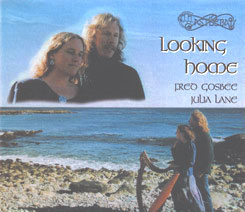
 Looking Home
Looking Home
Looking Home
This duo from Maine is two-thirds of the former group Castlebay, and has made an ample transition after the loss of Mark McNeil. Harpist and soprano Lane has mastered the delicate task of song accompaniment with her Celtic Harp and baritone Gosbee joins on 12-string guitar, whistles and 5-string viola. They reach all across folk music for their repertoire, from Scotland ("The Road to Drumleman") to Ireland ("Give Me Your Hand"), Maritime Canada("The Scarborough Settler's Lament" from a displaced Scot), New England ("Simple Gifts" ) and two originals
Though many of the works can be considered standards of the folk music scene, their presentations and arrangements render the pieces fresh and innovative. Special mention should go to the fine intertwining of the Irish Song "She Move Through the Fair" with the American song "Once I had a Sweetheart" in alternating lines. The title song which closes out the album should strike a common chord with many readers: it tells of their looking back to the lands their ancestors left behind as they prepare to visit a homeland they have never been to (and it is applicable to almost any foreign country)
The overall result is a fine and exceptionally pleasing album.
Some music just washes over you, and other music demands attention. The songs that Gosbee and Lane unearth (they each wrote one of the dozen songs here; the rest are traditional and not well-known) belong to the latter catagory. The songs they've gathered for Looking Home tie into the idea that all people are searching for the place they belong, whether in an ancestral sense or as part of a new enclave they've helped create themselves.
They open with "The Road to Drumleman," a song written with the Celtic countryside in mind but equally appropriate to Maine's many hidden byways. "Home Dearie Home" is a sailing ditty that now makes its fourth incarnation, after its origin in Britain and stays in Appalachia and Vermont. "The Harper's Song" chronicles the lifestyle of the traditional wandering minstrel, whose room and board depended upon him suitably impressing whatever household he might come upon.
The theme is carried forth in "She Moved Through the Fair / Once I Had a Sweetheart," "The Wild 'Prentice Boy" and a couple of lovely instrumentals, "Give Me Your Hand" and "The Lass of Peatie's Mill." There are also a couple of songs whose origins trace back to Canada (a little closer to home for many of us), "I'ze the B'y" and "The Scarborough Settler's Lament." (This Scarborough is now part of the city of Toronto.)
The record ends with Lane's "Something to Come Home To," a cautionary tale to anyone who might fancy wandering, and Gosbee's title song, itself awash in uncertainty. It opens with the line. "Looking home across the water to a land we've never seen" and ends with a question: "But what will we discover when we reach the other side?" Besides creating a thematically complete picture, Lane and Gosbee sing (especially she) and play beautifully. Though a little melancholy on the whole,
Looking Home is an artistic triumph.
All Our Recordings
Castlebay - 1988 The Long Isle - 1989 The Peat Fire Flame - 1990 Down To he Shore - 1991 Harvest - 1992 Angels We Have Heard (1)- 1994 Faeries Hornpipe - 1994 Looking Home - 1995 The Skye Suite - 1996 Angels We Have Heard (2) 1997 Song of the Sea - 1998 The Ballad of Cappy John - 1999 Ladies - 1999 In a Garden Green - 2000 Sea & Skye - 2001 Gentlemen - 2002 Yuletide Treasure - 2002 Cottage & Castle - 2003 Ae Fond Kiss - 2003 Imram - 2004 The Night the Whiskey Froze - 2004 Islands In Time - 2006 Banks & Braes - 2007 The Grand Design* - 2007 Harvest Home - 2007 Going Home - 2008 Rantin', Rovin' Robin - 2009 Bards & Blarney - 2009 2010 Yuletide Revelry - 2010 Imbolc - Rekindling the Flame* - 2010 Festival of Faeries - 2011 John Earthy's Tavern* - 2012 Bound Away - 2015 Samhain - Banking the Fire - 2017 Winter Moon - 2019 Bygone Ballads of Maine, Vol I (book) 2021 Sundrie Aires - 2023 The Maid on the Shore - 2024
* These recordings have extensive notes.


The Road to Drumleman 4:16
©1981 Willie Mitchell / Tony Cuffe. Iona Records
We first heard this lovely song from Nancy Mattila, a fine singer formerly from St. George, Maine. Although it was written about a Celtic locale it reminds us of those tantalizing side roads here in Maine that often lead to someplace that resonates with the heart.
N.B. Drumleman is the Scots way of saying Drumlemble.
Julia Lane - vocal, harp
Fred Gosbee - vocal, 12-string guitar
Oh the springtime returns to the Lagan again
And the lark sweetly sings o're the green fertile plain.
And I'll take the road that is dearest to me
The road the Drumleman that winds to the sea
for I've made many friends there on every green mile
And the folks always greet you with a wave and a smile
If I spent all my days there it's happy I'd be
On the road to Dremleman that winds to the sea
For we sat round the fireside when the winter winds blew.
And we laughed and we sang 'till the night was weel through.
And we had a wee dram and a good cup of tea
For the road to Drumleman that winds to the sea
And the long summer days when we tramped the hills o'er
Or spent hours at the headlands by Craigin's wild shore
And the soft summer twilight made shadows to flee
Fred the road to Drumleman that winds to the seas
All these days passing swiftly bring changes, I know.
And as time marches on from this place I must go.
But I'll always remember as the heart beats in me
The road to Drumleman that winds to the sea.
Home, Dearie, Home 2:53
Traditional
A Maine version of a Vermont version of an English song, this is a great example of the migratory nature of folk music. The napkin (sometimes cloth or kerchief) requested by the sailor is a clue to the origin. English sailors were distinctive in their habit of appleying tar to their hair to keep it out of their eyes (hence Jack Tar) The sailor in this song, gentleman that he is, requests the cloth to keep the tar from soiling the pillow (or the girl!).
Julia Lane - vocal, harp
Fred Gosbee - vocal, 12-string guitar
Home, dearie, home, and home it will be
Home, dearie, home, and home it will be
The oak and the yarrow and the pretty maple tree
Are all growing green in North Amerikee
As I walked out in Raspberry Lane
I chanced for to meet with a mistress of fame
The oak and the yarrow and the pretty maple tree
Are all growing green in North Amerikee
It was about midnight; what could he want more?
She showed him the way to the old cabin doorbr/>
He called for a candle to light him to bed
And likewise a napkin to bind around his head
Early next morning the sailor grew bold
And into her apron threw a handful of gold
The gold it did glitter and dazzled her eye
She said,"Oh, won't you marry me?"
"Oh no," he said, "Not I."
"Just keep yourself single until the next spring
To hear the lark whistle and the nightingale sing.
My ship it is a-waiting and in it I must go
To the land I love and the friends that I know."
The Harper's Song 3:32
Music © 1991 Bobbie Wayne ASCAP
Words by Sir Walter Scott (1771-1832)
In ancient times harpers traveled between the aristocratic houses playing for patrons and relying on their hospitality for a living. This romantic lyric came from Jack Downing's Song Book circa 1832, published by Seba Smith here in Maine. Probably inspired by the Celtic Twilight movement of the time, it was published without music. American harper Bobbie Wayne gave it new life with a beautiful tune.
Julia Lane - vocal, harp
Fred Gosbee - vocal, low whistle
Summer eve is gone and past
Summer dew is falling fast
I have wandered all the day
Do not bid me further stray
Gentle folk of gentle kin
Let the wandering harper in.
Bid me not in battlefield
Buckler lift nor broadsword wield
All my strength and all my art
Is to touch the gentle heart
With the wizard notes that ring
From the peaceful minstrel string
I have song of war for knight,
Lay of love for lady bright.
Fairy tale to warm the ear
Goblin grim, the maids to scare.
Dark the night and long till day.
Do not bid me further stray
Give Me Your Hand 3:00
Rory Dall O'Cathain (c. 1615)
Rory Dall O'Cathain was a blind Irish harper and a gentleman of considerable property. He took a fancy to visit Scotland having heard the great reputation of the harpers there. While paying a visit to one Lady Eglingtoun, she, apparently unaware of his rank, rudely demanded a tune. He irritably left the house. After discovering her faux pas the lady anxiously apologized and begged for reconciliation. This tune was his response.
Julia Lane - harp
She Moved Through the Fair / Once I Had a Sweetheart 5:22
Traditional Irish / Traditional American
Origially a traditional song She Moved Through the Fair was reworked by the Irish poet Padraic Colum, then passed back into the folk scene. These two songs flowed together naturally one evening. They are obviously related, the second being the immigrant grandchild of the first.
Julia Lane - vocal, harp
Fred Gosbee - vocal, 12-string guitar
My young love said to me, "My mother won't mind
And my father won't slight you for tour lack of kine.
She stepped away from me and this she did say,
"It will not be long till our our wedding day
She stepped away from me and she moved through the fair.
And fondly I watched her go here and go there.
She went her way homeward with one star awake
As the swan in the evening goes over the lake
The people were saying, "No two were e'er wed
Once I had a sweetheart but now I have none.
But one had a sorrow that never was said
Once I had a sweetheart but now I have none.
She passed close beside me with her goods and her gear
He's gone and leave me, he's gone and leave me
And that was the last I saw of my dear
He's gone and leave me to sorrow and mourn
I dreamed it last night, my young love came in
Last night in sweet slumber I dreamed I did see
So softly she entered her feet made no din
Last night in sweet slumber I dreamed I did see
She came close beside me and this she did say
My own precious jewel, my own precious jewel
"It will not be long till our wedding day
My own precious jewel sat smiling by me.
But when I awakened I found it not so
But when I awakened I found it not so
My eyes like some fountain with tears overflow.
My eyes like some fountain with tears overflow.
The Lass of Peatie's Mill 3:30
Traditional Scots / American
Music is as much a legacy as language. We found this tune of Scottish origin in a collection of populr tunes of colonial times in Williamsburg, Virginia.
Julia Lane - harp
Fred Gosbee - violin
The Wild 'Prentice Boy 2:05
Traditional Canada
I learnt this song from his grandfather, John West, who learnt it whilst working in the lumberwoods of New Brunswick before the family moved to Maine in 1922. This is his version of the song Newlyn Town probably dating to the 1750s.
Fred Gosbee - vocal, 12-string guitar, bowed psaltry
Doug Anderson - Bodhran
My name is Edward Houlahan
I was born in Erin's sunny isle
My father bound me to a trade
And they called me a flashing blade
At sweet sixteen I took a wife.
I loved her as I loved my life
To maintain her both wide and free
I took to robbing on the king's highway
I robbed Lord Darling, I do declare
I robbed them both of their gold so bright
And carried it off to my heart's delight
I never robbed a poor man yet
Or caused a tradesman for to quit
But from the rich gave to the poor
That's what brought me to this unhappy hour
For now I am condemned to die
And many a fair maid for me will cry
But all their tears connot pity me
For yonder stands the gallows tree
Let six bold robbers bury me
Give them broad swords and free liberty
And let six fair maidens bear my pall
Give them white robes and pink ribbons all
And when they speak, let them speak the truth
Here lies a bold and undaunted youth
I's the B'y 2:22
Traditional Newfoundland
An indiginous song, obviously inspired by the Scots and Irish who settled Eastern Canada and Maine. We met a man who remembered dancing to this song in his fishing boots with a girl on each
Julia Lane - vocal, harp
Fred Gosbee - vocal, 12-string guitar
Doreen Conboy - acoustic bass
's the b'y that builds the boat. I's the B'y that sails her
I's the b'y that catches the fish and takes them home to Liza
Hip you partner, Sally Tibbo. Hip your partner, Sally Brown.
Fogo, Twillingate, Morton's Harbour all around a circle
I took Liza to a dance and, faith, but she could travel
And every step that she did take was up to her knees in gravel
Susan White, she's out of sight. Her pettycoat wants a border
Old Sir Oliver, in the dark, he kissed her in the corner
Salts and rind will cover your flake, tea and cake for supper
Codfish in the spring of the year, fried in maggoty butter
The Scarborough Settler's Lament 3:50
Traditional, Canada
n 1840 Sandy Glendenning, a displaced Scxot who settled in Scarborough, Canada (now part of urban Toronto) penned these lyrics to the old Scottish tune Of All the Airt's the Wind Can Blaw. Where I learnt this tune is lost in the mists of time. I think it might have been a late night at the old Ram's Horn in Orono, Maine.
Fred Gosbee - vocal, 12-string guitar
Julia Lane - vocal
Doreen Conboy - cello
Away with Canada's muddy creeks and Canada's fields of pine.
Your land of wheat is a goodly land but, oh, it is not mine.
The heathy hill, the grassy dale, the daisy-splngled lea,
The purling burn, and the craggy lin; old Scotia's land give me.
How I'd love to hear again the lark on Tinny's Hill
Or see the wee-bit gowan e'e that blooms beside the rill.
Like banished Swiss who views afar his Alps with longing e'e
I gaze upon the morning star that shines on my country.
No mre I'll wend down Eskdale's ben or Pentland's craggy cone.
The days will ne'er return again of thirth years that's gone.
But fancy, of't at midnight hour, will steal across the sea
And yestere'en, in a pleasant dream, I saw my own country
Each well-Known scene that came in view brought childhood joys to mind.
The blackbird sand on Tushy Linn the song he sang lang syne
And I awoke in Canada, three thousand miles fra' hame.
Simple Gifts 1:55
Traditional Shaker
Religious freedom was one reason for immigration to north America and the Shakers were one of the many groups to do so. One of the oldest (c 1794) and the last remaining Shaker community is at Sabbathday Lake, Maine. Famous for their legacy of enduring, functional elegance and joyous commitment to work, their music reflects their beliefs.
Julia Lane - harp
Something to Come Home To 2:53
© 1983 Julia Lane
Written for a friend.
Julia Lane - vocal, harp
Fred Gosbee - 5-string viola
Gary Clancy - guitar
Doreen Conboy - cello
Travel down the road. Go where your heart may lead.
Just remember we all need
Something to come home to.
Somewhere down the way you'll find yourself returning
To good friends and hearthfires burning
And wanting something to come home to.
Turn your head. Play your games. Make up alibis.
You may not even feel the pain until you realize
It's a long hard road and some may leave you crying
But the thing that keeps you trying is having
Something to come home to.
Looking Home 7:27
©1992 Fred Gosbee
I made this song while we were preparing (with some trepidation) for our first trip to Ireland and Scotland. Thanks to Lincoln Academy for help with the voices of our ancestors, music of another sort.
Fred Gosbee - vocal, 12-string guitar
Julia Lane - vocal, harp
Lincoln Academy students - babble
Looking home across the water to a land we've never seen
Lookin home across the water; we just know you from our dreams.
But the songs the old folks sing and the stories that they tell
Make us believe, within our hearts, we know you very well.
Our mothers and our fathers came here many years ago.
Some left their homes willingly. Some were forced to go.
Poverty, rebellion, or politics gone wrong;
Whatever were the reasons their love of home was strong
Bitter must have been the parting there upon the quay.
But they turned the bow to west'ard and sailed acreoos the sea.
Some were filled with courage; others weak with fear
Coming to an unknown land away from friends so dear.
After they had landed here upon this distant shore
Our people built a new life, maybe better than before.
Their spirit was rewarded, their strength of hand and heart.
Still they missed the land behind and friends that had to part.
Now generations later, as strangers we return.
The memories have faded but still the heart will yearn.
We look to our beginnings; our source of strength and pride.
But what will we discover when we reach the other side?
2019-12-02 © Castlebay Music
email us