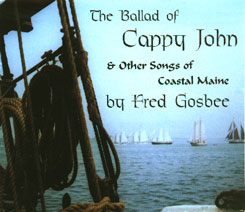
 The Ballad of Cappy John
The Ballad of Cappy John
The Ballad of Cappy John
I had the good fortune of spending my vacation this year in Boothbay Harbor during Winjammer Days and stumbling upon your concert. I really enjoyed your music, so much so that I was the first to buy your new CD, and the next day I bought two more at Sherman's [Bookstore] . I'm listening to The Ballad of Cappy John right now.
I think that Maine is such a special place and now your music can help me go back there whenever I want (without the ten hour drive). Every now and then you experience a "perfect moment", and sitting listening to you in Boothbay Harbor was one of those. I just wanted to thank you for that.
Sincerely,
K. S. , Waterloo, NY
.
Castlebay - 1988
The Long Isle - 1989
The Peat Fire Flame - 1990
Down To he Shore - 1991
Harvest - 1992
Angels We Have Heard (1)- 1994
Faeries Hornpipe - 1994
Looking Home - 1995
The Skye Suite - 1996
Angels We Have Heard (2) 1997
Song of the Sea - 1998
The Ballad of Cappy John - 1999
Ladies - 1999
In a Garden Green - 2000
Sea & Skye - 2001
Gentlemen - 2002
Yuletide Treasure - 2002
Cottage & Castle - 2003
Ae Fond Kiss - 2003
Imram - 2004
The Night the Whiskey Froze - 2004
Islands In Time - 2006
Banks & Braes - 2007
The Grand Design* - 2007
Harvest Home - 2007
Going Home - 2008
Rantin', Rovin' Robin - 2009
Bards & Blarney - 2009
2010 Yuletide Revelry - 2010
Imbolc - Rekindling the Flame* - 2010
Festival of Faeries - 2011
John Earthy's Tavern* - 2012
Bound Away - 2015
Samhain - Banking the Fire - 2017
Winter Moon - 2019
Bygone Ballads of Maine, Vol I (book) 2021
Sundrie Aires - 2023
The Maid on the Shore - 2024
* These recordings have extensive notes.


Fred has designed and built many instruments including guitars, lutes, harps, and whistles. In addition to his musical career, he has extensive experience in engineering, carpentry and ship-building. With Julia Lane, Fred has toured the Eastern U.S., Ireland, England, Scotland, and Kosovo playing at arts centers, folk clubs, festivals and schools.
Fred plays too many instruments on this recording including 12-string guitar, 6-string guitar, 5-string viola, Fiddle, Bass, Mandolin, Tin Whistles, Dobro, Harmonica, Dijeridu, Bok Whistles, Bowed Psaltry.
"These songs are my sketches of some of the folks who have lived and worked on the Maine coast over the last 300 years. The Maine character has always been shaped by our close connection with the land and the sea. It isn't always an easy relationship. A hard land with a hard climate means a lot of hard work, but beneath the tough hide that these folks wear is a heart that understands the value of community and of belonging to a place."
---Fred
Shantyman's Hail 3:09
©1984 Fred Gosbee
This is a thumbnail sketch of the ups and downs of the maritime industry. This song was used in the Turner Broadcasting Company's series Portrait of America for the 60-minute Maine episode.
   Hey, Ho! Roll and go!
   Round Cape Horn to San Francisco
   Shanteyman sing, boys, pull on the line
   And we're back in record time

At Bath down in Maine they built many tall ships
They were faired up and planked, then launched down the slips
The strength of our nation was built on the pine
Of the mast-trees that harnessed the wind
There were schooners and sloops and all kinds of small craft
Warships with cannon both foreward and aft
And the queens of the seas, the graceful clippers
Mighty proud men were there skippers

CHORUS

Then the steam-powered ships came along
Their engines replaced the shanteyman's song
And men in the hellish heat down in the hold
Spent their watches shoveling coal
First coal, then oil, then nuclear heat
Replaced all the wind-driven ships in the fleet
And skills handed down for hundreds of years
Have all but disappeared

CHORUS

And where went the tall ships that once sailed so free
Under clouds of white canvas across the salt sea
With the wind in their rigging and foam at the bow
Tell me,  where are they now?
Well some were scrapped and some can be found
Like the Luther and the Hesper, up the Sheepscot aground
Some were towed out to deep water and sunk
Regarded as no more than junk

CHORUS

We can't live forever on fuel from the ground
The prices go up and no more will be found
If we're still around for the next age of sail
We might hear that shanteyman hail

CHORUS
The Ballad of Cappy John 3:54
©1991 Fred Gosbee
This started out as a joke but as time has gone on I have found that truth is stranger than fiction. Several daughters and wives of old fishermen have told me "... you know my man would NEVER go out in a fog if he had a cold. Couldn't smell the ledges!" The rockweed that grows on our Maine ledges does have a distinctive odor, so I guess the joke is on me .
The Mary L. MacKay is actually the Effie Morrissey which sailed from Portland, Maine, to Yarmouth, Nova Scotia, (a distance of 220 nautical miles) in eighteen hours back in December, 1913. There is a rousing song about the passage with words written by Frederick William Wallace and published in the Canadian Fisherman magazine in 1914. Portland rum figures heavily in the account.
The schooner went on to become famous for numerous expeditions to the arctic. She still sails today under the name "Bowdoin"
Come all of you brave schooner boys who sail the coast of Maine
Listen to my story and join in the refrain
It's all about a skipper, the best we ever knew
He sailed a stout 4-master with a tough and jolly crew
Many a tale that I could tell you never would believe
Like coming into Pemaquid on a stiff Sou'east'ly breeze
To sail with him the Thread of Life took the courage of a saint
For he'd take the barnacles off her hull but he never touched the paint

  He had one eye on the waves, the other on the weather
  He saw more with his swivel eye than all of us together
  He could find his way on a moonless night dark as dungeon cell
  And when the fog was thick as soup, he'd navigate by smell

The tale that I will tell you of began in the usual way
Going to Yarmouth town we passed the Mary L. McKay
We left our cargo on the dock and then stood out for sea
And we met her staggering into port like a drunkard on a spree
Things was fine we was making time on a wind from the Nor'east
When Cappy John says 'Gorry boys, I don't like this in the least
I can tell by the sky and the look of the foam that when the sun goes down
We're gonna be in for a Heluva fog or I ain't Cappy John'

CHORUS

We'd been with Cappy in fog before so we weren't worried none
We figgered we'd make Portland by the rising of the sun
So we stood our watches with hearts as light as swallows in the spring
We didn't know Cappy had caught a cold and he couldn't smell a thing
And Cappy he didn't let on none, why God only knows
Maybe he figgered to steer by sound and wouldn't need his nose
And he didn't tell us to shorten sail though we might have heard him sneeze
Then we plowed right into that bank of fog like a maggot into a cheese

CHORUS

Then Cappy hollered 'Look sharp, boys, I fear we're close to land'
But that fog it was so goldurn thick you couldn't see your hand
And the ship was sailing very queer, up great rough seas and down
We heard strange sounds like moaning groans of sailers who'd been drowned
When the sun came up, 'twas off our stern 'stead of the larboard side
Then, Mister Man, we came to know we'd been on a Heluva ride
For we stood in a field five miles from shore - captain, ship and crew
He lost his way 'cause he couldn't smell but he brought us in on the dew!

CHORUS
Ramona 5:28
©1991 Fred Gosbee
I got this story from James E. Stilphen of Bath, Maine, who paints ships portraits and is deeply imbued with local maritime history. While he knew the story and location of the ship, he couldn't remember her name so I used Ramona for the chorus until I could find her real name. In the spring of 1991, after I had made the song we took a day and went to Five Islands and found her. She is the 240 foot 5-masted schooner Margaret F. Barret, run aground in 1929 by one Levi Topman. There is indeed a house there made from some of her timbers. She has a pretty big hole in one side and at half-tide you can go inside the hull with a Boston Whaler.
Guest musician
Mark McNeil - cello
The wind in her rigging sings a song of other days
Though her masts are sprung and there's slack in all her stays
I close my eyes and I remember how it used to be
When me and my Ramona  went to sea

   Now she don't look like much lying here beside the shore
   And me and her won't ever see deep water anymore
   We're a couple of old derelicts from another time
   Me and my Ramona

We started hauling lumber, ended hauling coal
I was twenty years her master and I loved her heart and soul
So many times she saved us from the fury of the storm
After all these years my memories are warm

CHORUS

I recall how on our last trip when we'd emptied out the hold
The owners came down to me, said Ramona  had been sold
They sold her to a scrapper 'cause they couldn't make her pay
I had to get my gear and go away

CHORUS

I couldn't leave here there after all she'd done for me
So I gathered my life-savings and I paid Ramona's  fee
Took her up the river and beached her in the sand
Then built this little cabin close at hand

CHORUS

It's been thirty years now since we come aground
Still I walk her weathered deck and think I hear the sound
Of a living tops'l schooner as she runs before the wind
Oh, Ramona, we're still sailing in my mind

CHORUS
The Fisherman's Life 2:48
©1984 Julia Lane
Julia wrote this for an old lobsterman, "Tinker", who has since passed away. It is indicative of the attitude of many of the fisherman who would rather fish than anything else.
Guest musician
Julia Lane - harp, vocal
Well it's up in the morning and stumble downstairs
Have a cup of good coffee to drive chills away
Than it's on with my boots and I'm down to the dock
And by sunrise I'm down the bay

	And it's oh, to be fishing upon the sea
	The fisherman's life is the only for me
	Be it hauling or seining it's borne in the blood
	And by sunrise I'm down the bay

Well I have tried working at many a thing
I forgot how to live, I forgot how to sing
I longed for the feel of the sea 'neath my feet
Even though it's not regular pay

CHORUS

My father before me has worked on the sea
And he's passed his experience down to me
I learnt to set traps, and I learnt how to wait
And I learnt what not to say

CHORUS

Someday I'll get old and my legs'll be sore
And they'll tell me I can't go out fishing no more
But I'll smile as my boat turns away from the dock
And I'll sing as I go down the bay

CHORUS
Clamdigger 3:05
©1991 Fred Gosbee
This chant is for all those folks who larbor harder and live on less than most of us can imagine is possible. It's a tough life and sometimes the only thing that keeps these people going is the pride of hard work.
You think that diggers have a life of ease
You think they come and go just as they please
In the air and in the sun
A peck or two and then they're done

  Ho clams! You need 'em for chowder
  Ho clams! You eat 'em with fries
  Ho clams! I'll be a digger, I'll be a digger until the day I die

See that old clamdigger in the mud
I guess that digging just gets in your blood
As long as he has kids to feed
His boots and hoe are all he needs

CHORUS

A digger sets his timepiece by the tide
Goes down to the shore when flats are wide
Bends his back and pulls his hoe
Digs as fast as he can go

CHORUS

In wintertime it's cold but still we go
Out on the flats although it's ten below
That onshore breeze is awful chill
If diggin' don't get you the frostbite will

CHORUS

In summertime the diggin' days are long
You get two tides a day if you are strong
Then when you think you're getting ahead
The state man says the tide is red

CHORUS

Red tide means that you can't sell your clams
Means you have to scuttle all your plans
Feed the kids; put off the rent
You have to scrape for every cent

CHORUS

In a restaurant or in your home
Now that you have listened to my song
When you sit and eat your clams
Just remember who I am

CHORUS
Muscongus Hornpipe 1:53
7copy;1999 Fred Gosbee
Muscongus is the old name for Loud's Island, which is about a half mile off Round Pond where we live. The last of the year-round population moved off the island about 1978. There is still a sizable summer community. There is no electricity, no roads or vehicles and (prior to the advent of cell phones) no telephones. It is a good place to slow down. Muscongus seceeded from the United States in 1860 and didn't rejoin until 1935.... but that's another story.
Guest Musician
Julia Lane - harp
The Old Liars 4:01
©1993 Julia Lane
Julia Lane, Claire Curtis: Chorus Vocals
Julia made this song from memories of the old fishermen who held court in New Harbor when she was a child. These old men provided a watchful eye as the youngsters played in ways that would be unthinkable to today's parents - sinking each others skiffs, throwing bait juice at each other and searching for treasure under the docks. The names and faces are all real, even though they are all gone now.
	Oh what has become of the old liars all
	Julian and Manley and Frankie and Paul?
	Down at the co-op when fish weren't so few
	They'd lie through their teeth and they'd swear it was true

On warm afternoons in the summer we'd go
With handline and bucket to the harbor below
To the dock with the rope and the chains and the spars
Where the weathered old planks smelled of bait and of tar
The fish house was piled high with old fishing gear
With a sign that said something 'bout "All the bull here"
In a big leather armchair a white-haired old man
Would give us a soda and a handful of clams

CHORUS

Sometimes there were others who sat in the shack
A-telling their stories of fishing 'way back
When the weather was better or worse than right now
They always would say it was bigger somehow
They'd tell of the days when they hauled traps by hand
Out in their dories away from the land
In the winter they'd row till their hands would turn blue
And some of the stories you knew could be true

CHORUS

But then they'd continue with never a smile
And tell of the day when they rowed fifty miles
Blinded by fogbanks and capsized by storms
And rescued by mermaids with gold on their arms
Then there was the one 'bout the fisherman's ghost
Doomed to eternity because of a boast
His coming would warn all the sailors of gales
The wilder the weather, the stranger their tales

CHORUS

Then we'd run down the gangplank and bait up our lines
And drop the weight down where the flounder are fine
We'd wait for the tug that sometimes never came
Then we'd go up and bother the old men again
And now that they're gone I feel empty inside
Though people will tell me their jaw was all lies
Their tales were as true as the tide and the breeze
My children will never hear stories like these

CHORUS
Stone Sloops 3:48
© 1995 Fred Gosbee
This song was commissioned by Robert Brown of Chebeague Island for the Island Historical Society. He said that he would "rather have it right than Tuesday" so it took me a while to get it together.
Mark McNeil- guitar, bass, chorus vocals
In the 19the century along the coast of Maine
There used to sail a fleet of ships there's none like them today
Built for heavy hauling gravel stone and sand
There were no donkey engines then, men pulled the lines by hand
They carried just a singlremast to keep the wide deck clear
The heavy boom when tied athwart left room for lifting gear
They were not built for beauty, they were not built for speed
But for a hundred years or more they served our country's need

	Stone sloops from Eastport to Chebeague
	Preferred for heavy hauling to ship or schooner rig
	Stone sloops sailing far and wide
	For a hundred years and more they were the people's pride

After independence our nation was in need
Of stone to build our cities and stone to pave our streets
Quarries by the hundred were along the coast of Maine
To get that stone to market was the stone sloops aim
90 feet in length 30 feet from rail to rail
With a thousand yards of canvas in a single mighty sail
Owned by the captain, named for the captain's wife
It wasn't just a business it was a way of life

CHORUS

The sloops would set out in the spring to find a job to do
With a captain and a mate and a boy to cook for crew
They would work way down in Canada, in Boston or New York
Until the end of June they would stay where there was work
July they'd sail for home just to see the family
But after picnic and parade they'd all return to sea
And be gone until November when the wind began to freeze
Then home to moor for winter in some protected lee

CHORUS

As the years went rolling on fewer sloops set sail
Just a sign of changing times replaced by truck and rail
Junked out and abandoned another one each year
With hardly any notice the stone sloops disappeared
So all that's left is memories and stories handed down
But now it's been collected and in a book it's bound
The ships the captain's families, the tales the old salts tell
The folks down on Chebeague they have kept these treasures well

Chorus
The Whale Hunters 2:54
© 1993 Fred Gosbee
Although Maine was never a center for commercial whaling, ships were built here for the purpose and whales were abundant in our coastal waters
Mark McNeil- bass, percussion
We set out from Portugal in 1634,
Sailed to Baffin Bay and built our tryworks on the shore.
We had come to hunt the right whale and there they did abound.
There were whales in that bay to last forever.

Set your iron, throw the lance and make the kill.
Tow him to the shore; bend your back, boys, with a will!
When that oil is in the hold it will be as good as gold
And there are whales enough to last forever.

We set out from New Bedford in 1853;
To find our catch of whales we had to search the seven seas.
Right whales being scarce we took the humpback sperm  & gray
But the seas are wide enough to last forever.

Set your iron, throw the lance and make the kill.
Tow him to the ship; bend your back, boys, with a will!
When that oil is in the hold it will be as good as gold
And there are whales enough to last forever.

We left our port in Russia in 1951
In a deisel powered factory ship armed with a harpoon gun.
The blue and fin that were too fast we now run down with ease
And those whales are big enough to last forever.

Fire your gun let the harpoon make the kill;
Winch him up the ramp and run him through the mill.
When that oil is in the hold it will be as good as gold
And there are whales enough to last forever.

It's 1995 as we set out from Japan;
This is not commercial whaling for there is a whaling ban.
We take them for the research but we don't waste the meat
And we still make profit 'cause we're clever.

Fire your gun; let the harpoon make the kill;
Winch him up the ramp and run him through the mill.
When that oil is in the hold it will be as good as gold
And we'll get our share before they're gone forever.

Fire your gun; let the harpoon make the kill.
We can get around the treaty with our diplomatic skill.
When that oil is in the hold it will be as good as gold!
Song fot Stan Hugill 2:18
©1986 Fred Gosbee
Englishman Stan Hugill, a shanteyman himself in the 1920s, collected the songs later in his life and was instrumental in preserving them and reviving the tradition. We saw him, in his eighties, singing lustily from the rigging of the Charles W Morgan at Mystic Seaport.
Julia Lane, Claire Curtic: Chorus vocals
Lay onto the line one more time, old man
Sing out and give us a working rhyme
	Pull for the old man
These days the sails are just for show
But now before you have to go
Tell us how it was so long ago,old man

	Pull for the old man pull
	We won't see his like again
	Pull for the old man pull
	Pull for old Stan

Your eyes have seen the working sail, old man
In summer sun and winter gale
	Pull for the old man
You've seen the sail replaced by oil
Gone the tops'l, course and royal
And the songs that helped you with your toil, old man

CHORUS

Your mind is sharp, your eyes are clear, old man
And your arm's still strong after eighty years
	Pull for the old man
With your tatooed arm and rolling gait
Your silver hair and your beard so grey
You're a bridge through time to yesterday, old man

CHORUS

So have a drop of Nelson's blood, old man
Then tell us about that scouse and grog
	Pull for the old man
Within your songs and books we find
The treasures you've had in your mind
We thank you, you've been very kind, old man

CHORUS
Cappy John's Bride 5:18
©1996 Fred Gosbee
Julia thought that Cappy John might need a new boat after his adventure in the title song, so she put me up to writing this little ditty which was inspired by two sources. One was a song written in Prince Edward Island by Lawrence Doyle (1847-1907) about a deal concerning a horse. I sang it for Morag Henricksen of Skye who told us that the same tradition still exists in the Outer Hebrides only the deal involves a boat.
Goomer is a Maine-ism that means, roughly, "oaf". There is a word from old English, gomer, which originally meant groomsman or perhaps knave which has evolved from meaning the man who curries the horse to the man who marries the bride. Are they related? Who knows.
Bundling is an old Canadian and New England custom where a courting couple is allowed to sleep in the same bed with a barricade of bolsters or sometimes a plank between them. These were supposed to act as speedbumps on love's highway.
When you sing this song, remember - it's about a boat!
Julia Lane - harp and vocals
Now a skipper that we know who was famous long ago
Was looking for a ship as his was run aground
Though it was sometimes stated 'twas the way he navigated
Ol' Cappy John was rated as  the finest man around

Now there was a ship nearby that he wanted for to try
It belonged to Ned McKenzie and was called the Mary Beale
But old John was shy of girls and the place was full of curls
And he didn't have the nerve to go up and make his deal

	She carries her bow high and her stern is nice and round
	It's easy to hold her when she's sheeted down
	She is my heart's desire and all that I require
	Is that you let me try her when I come to town

Now the mate, whose name was Dan,
Up and says to the old man
"I can sound McKenzie out and then clear away the girls
I will see that it's alright if you want to go tonight
For that ship she is a sight, she's the best in all the world"

So Dan goes to McKenzie but somehow in all the frenzy
There was some misunderstanding
And he got the message wrong
Or perhaps the silly goomer had a twisted sense of humor
But when Cappy came to woo her he was singing this song

CHORUS

McKenzie shook his hand and he says "I understand
that you want to take my Mary away from me
Now before with you I send her I must tell you she is tender
Which I'll thank you to remember when you take her out to sea"

So John says "Dan must have told that I want to fill her hold;
With a belly full of cargo I know she'll handle fine
I promise not to break her and if ever I forsake her,
Then I know the mate will take her for he's a friend of mine"

CHORUS

Says McKenzie "Are you mad? for you talk just like a cad
To throw my Mary over like some trollop in Rangoon
She isn't just some fun thing (though I might permit some bundling)
And now I will tell you something, you must make your offer soon"

Says John "I can't commit until one thing you  permit
You must let me  roll her over on the sand beside the bay
I will have my men inspect her and still I may reject her
If  her bottom is neglected or has started to decay"

CHORUS

Says McKenzie "I can't stand it; you are worse than any bandit
Since the two of you have planned it  'tis yourselves that should begin"
He called Mary from the kitchenl; Cappy John he started twitchin'
But the girl she was bewitchin' and she smiled as she came in

Now the mate, he oiled the water, and the skipper got the daughter
He's as happy as an otter with his dear and blushing bride
Though it seemed a bright invention  he'd the good sense not to mention
That it wasn't his intention,  AND HE GOT THE SHIP BESIDES!
Changes 5:30
© 1996 Fred Gosbee
I have been blessed in my lifetime to see the revival of rivers here in Maine. The Clean Water Act of the 1960's was initiated in the U.S. Senate by the Maine Delegation and became the lynchpin for the environmental reforms which have led to improving air and water quality since then all across the country. You can't let your guard down, though. There always seem to be people out there who cut corners to save a little cash for their interests, usually stockholders these days. When something goes wrong we all pay in many ways
Julia Lane: Celtic harp
Claire Curtis: Concertina, chorus vocals
Gary Clancy: Bass
	The river runs down and the tide rolls in
	It's the same way now that it always has been
	The changes in the river, the changes in the sea
	Are the changes made by you and by me

What is more lovely than the light on the water
As the moon rises over the bay?
What is more peaceful than a murmuring stream
in the warmth of a long summer's day?
When life gets too crazy and things move too fast
I go the the river and find
The hours spent listening, the hours spent watching
Can bring a deep peace to my mind

CHORUS

Well I remember the streams in the forest
Where I wandered when I was a boy
It seemed to be magic, for each time I'd  go there
Was a time filled with wonder and joy
Fishing for trout at the old beaver dam and the log where I sometimes fell in
A time of adventure, a time of exploring;
I wish I could be there again

CHORUS

Most of my life I have lived near a river
A lake or sometimes the sea
I know well the power, have seen all the fury
But that's not what's troubling me
For I have seen greedy ones poison the waters
For the sake of a few dollars saved
When the waste from the mills or the oil that is spilled
Turns a living world into a grave

CHORUS
Waiting for the Snow 3:33
©1987 Fred Gosbee
I wrote this at a time in my life when I finally got it figured out (some of us are slow learners...)
Julia Lane: Vocals
October's gone, November's here and the trees are standing bare.
Their ragged robes of red and gold have blown away somewhere.
The crops are in, the wood is split, you have no place to go
So bank your fire, settle in and wait for the snow.

That same old wind who stole the leaves now prowls around your door,
Creeps unasked into your house and reminds you what's in store
For he tells you of the days ahead, but you don't want to know
So bank your fire settle in and wait for the snow.

You've heard that old North wind before when another shared your bed;
Held you warm from dark till dawn from the lonliness you dread,
But this time no one goes with you; this time you want it so
So bank your fire, settle in and wait for the snow

	You know that winter's on the way; you can see it in the moon,
	Cold and pale as a comet's tail; the sun goes down too soon,
	And Orien's hunting across the sky with his starry belt,
	And you know that he won't go 'till the snow begins to melt.

Another year is over. Turn another page.
That old North wind around your head makes you feel your age.
You're alone but not so lonely as you were awhile ago
So bank your fire, settle in and wait for the snow.
Rolling Home 4:40
©1984 Fred Gosbee
It was years after I had written this song before I heard the double chorus the way I had imagined it in my mind's ear. We were touring Maryland and had a wonderful audience in St Marys City that really sang it well
Julia Lane - Vocals, Celtic harp
   Rolling home in the morning at the break of dawn
   Rolling home 'cross the ocean where I've wandered for so long
   Rolling home to my darling that's where I belong
   Blow ye winds, run ye tides back to harbor

A sailor's life is dreary far from home
He's often wet and weary out on the salty foam
He is gone for a year, often times more
Hoping that his deary's waitin' for him

CHORUS

Do you want a trip to China? Well, sign on board
Or down under to Australia, pick up a load of wool
Trade for tea in India then bear for home
Hoist the sail, haul the anchor, head for harbor

CHORUS

It isn't very funny when your pay is counted down
There's not a lot of money for the time that you've been gone
So you hug and kiss your honey and hold her while you can
Till the captain says "We're leaving in the morning"

CHORUS

Some men love adventure and some love the sea
Some only love whisky and some love being free
But the only love I need is the love of my lady
Blow ye winds, run ye tides back to harbor

CHORUS
p>
2019-12-02 © Castlebay Music.
email us